
The Battle of Kadesh: Ramses II’s Epic Clash and the Turning Point of the Bronze Age
The Battle of Kadesh stands as one of the most legendary military encounters of the ancient world, a grand confrontation that pitted the might of Pharaoh Ramses II’s Egyptian Empire against the formidable Hittite forces under King Muwatalli II. Taking place around 1274 BCE near the Orontes River, close to modern-day Syria, the battle was not just a fight for supremacy but a dramatic chess match between two of the most advanced civilizations of the Late Bronze Age. Its outcome shaped the power dynamics of the ancient Near East for decades, influencing diplomacy, warfare, and how rulers recorded their victories for posterity.
This was far more than a chaotic clash of chariots—it was a testament to the strategic wit, courage, and propaganda mastery of Ramses the Great. The Battle of Kadesh remains one of the earliest and best-documented military engagements in human history, thanks to inscriptions carved across temple walls, especially those adorning the Karnak Temple and the Temple of Seti I. These vivid accounts evoke the tension, the ambition, and the enduring legacy of Egypt’s imperial might. Historians often hail it as the world’s first recorded peace treaty and a symbolic milestone of international diplomacy.
Understanding the Battle of Kadesh is essential for anyone exploring the depth of Ancient Egyptian history, its royal ambitions, and the evolution of early geopolitics. From the clash of bronze weapons to the thunder of 5,000 chariots, this defining confrontation marks a fascinating intersection of military muscle, political intrigue, and historical narrative. It’s a tale that continues to mesmerize archaeologists, military scholars, and travelers who walk the ancient lands of Egypt and Syria today.
Setting the Stage: The Rivalry Between Egypt and the Hittite Empire
Before the dust of Kadesh ever rose, the ancient world was divided between two great powers: Egypt and the Hittite Empire. The Hittites, based in Anatolia (modern Turkey), had expanded their control into Syria, threatening the Egyptian sphere of influence in Canaan. This encroachment directly challenged Ramses II, whose ambition matched his divine image as the living god of Egypt. The Pharaoh’s vision wasn’t limited to ruling the Nile Valley—he sought to reclaim former Egyptian territories lost during prior reigns.
For centuries, the Levant had served as a crossroads of trade and culture. Whoever controlled it held the keys to commerce, diplomacy, and prestige. The Hittites and Egyptians both coveted the city of Kadesh, a strategic hub along trade routes linking Mesopotamia, Anatolia, and the Mediterranean. Control of Kadesh meant dominance over the region’s wealth and influence—a prize neither empire could ignore. The escalating tension turned diplomacy into open conflict, setting the stage for one of antiquity’s most monumental battles.
Modern historians compare the Hittite-Egyptian rivalry to Cold War superpowers, each maneuvering through alliances, espionage, and propaganda. As Ramses II marched north, his army carried not just weapons but the weight of Egyptian pride and divine destiny. Even today, travelers exploring the Egyptian Museum of Cairo can find reliefs depicting Ramses’s valor, forever immortalizing the Pharaoh’s quest to seize Kadesh and outshine his Hittite rivals.
Ramses II’s Military Might and the Egyptian Army
Ramses II was no stranger to power or spectacle. Known as Ramses the Great, his reign symbolized Egypt’s golden age of expansion, architecture, and artistic glory. His army was organized, disciplined, and innovative, featuring divisions named after the gods Amun, Ra, Ptah, and Set. Each division included thousands of soldiers, archers, infantrymen, and charioteers—a combined force exceeding 20,000 men.
The Egyptian chariot, light and maneuverable, was the pride of Ramses’s forces. Pulled by two horses and operated by a driver and archer, it became the ancient equivalent of a modern tank. Ramses himself led the Amun division, riding in a chariot adorned with gold and carved with divine symbols. The Pharaoh’s belief in his divine backing emboldened him, even as he walked into one of history’s grandest ambushes.
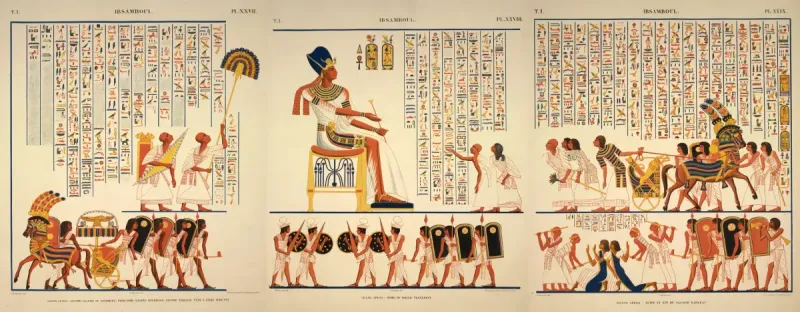
As Ramses marched toward Kadesh, he underestimated the cunning of Muwatalli II, whose spies and misinformation campaigns caught Egypt off guard. This tactical oversight nearly led to Ramses’s downfall—a moment that reshaped his image as both warrior and survivor in Egyptian history and the art of military storytelling. Visiting Abu Simbel Temples, travelers can still see carvings immortalizing Ramses’s heroism at Kadesh, a powerful blend of art and propaganda that glorified his near-miraculous escape from disaster.
The Hittite Strategy: Muwatalli II’s Deceptive Genius
King Muwatalli II wasn’t about to surrender his stronghold easily. A shrewd tactician, he gathered an army exceeding 40,000 men, including 3,500 heavy chariots capable of breaking enemy lines. While Ramses’s army advanced with confidence, Muwatalli laid out an elaborate trap near the Orontes River. Deceptive scouts, posing as deserters, misled Ramses into believing the Hittites were far away. The truth? They were lurking close, ready to strike.
This cunning ruse became one of the earliest documented uses of psychological warfare. As Ramses pitched camp near Kadesh, confident in victory, the Hittite chariots swept down in a sudden ambush, smashing into the Egyptian Re division and forcing chaos through the ranks. What followed was a desperate fight for survival—a test of leadership that defined Ramses’s legacy.
The Turning Point: Ramses II’s Courage Under Fire
In the midst of panic, Ramses II rallied his remaining forces. Facing overwhelming odds, he took command of his personal chariot and charged into the heart of the Hittite assault. His inscriptions recount how he “fought like Montu,” the Egyptian god of war, single-handedly turning the tide. Though modern historians suspect embellishment, there’s no denying Ramses’s tactical recovery saved his army from annihilation.
Reinforcements from the Ne’arin—Egyptian allies from Amurru—arrived just in time, pushing the Hittite forces back toward Kadesh. The battle raged for hours before ending in a bloody stalemate. No side could claim absolute victory, yet Ramses’s propaganda machine ensured that his triumph was etched in stone. The Pharaoh’s portrayal as the savior of Egypt became a timeless symbol of resilience and divine kingship.
The Aftermath: From Battlefield to Peace Treaty
After the dust settled, both empires recognized the futility of endless conflict. The Battle of Kadesh led to one of the first recorded peace treaties in human history, signed around 1258 BCE. This landmark agreement between Ramses II and Hattusili III (Muwatalli’s successor) established mutual respect, non-aggression, and even royal marriages to strengthen diplomatic ties. It marked a revolutionary step toward structured international relations in the ancient world.
Copies of this treaty survive today, one in hieroglyphs at Karnak, and another in Akkadian cuneiform in Anatolia. The United Nations even displays a replica in its headquarters—a tribute to humanity’s earliest commitment to peace through negotiation rather than perpetual war.
The Legacy of the Battle of Kadesh in Egyptian History
The Battle of Kadesh wasn’t just a chapter in Egypt’s military chronicles—it was a cornerstone of its cultural identity. Ramses II used it to solidify his image as Egypt’s ultimate warrior-king, commissioning grand reliefs across temples from Luxor to Abu Simbel. These depictions didn’t just glorify a battle; they reinforced the divine legitimacy of pharaonic rule itself.
Moreover, the battle’s diplomatic outcome reshaped Egypt’s foreign policy. For nearly a century afterward, Egypt and the Hittite Empire maintained relative peace, allowing trade and art to flourish. Modern visitors exploring Luxury Egypt Tours or Best Nile River Cruises often marvel at the grandeur of the temples where Ramses’s victories were immortalized, realizing that these monuments are not mere relics—they’re echoes of a nation’s pride and diplomatic evolution.
Archaeological Discoveries and Modern Interpretations
Archaeologists continue to unearth artifacts and inscriptions that refine our understanding of the Battle of Kadesh. Reliefs, weapons, and diplomatic tablets reveal a nuanced tale—one of propaganda, valor, and political calculation. The balance of power between the Hittites and Egyptians reminds modern historians that even the mightiest empires depend on negotiation as much as conquest.
For travelers exploring the ancient wonders of Egypt—from the Luxor Temple to the Colossi of Memnon—the legacy of Ramses II and the Battle of Kadesh continues to inspire awe. It’s a reminder that history’s greatest battles aren’t only won by swords but also by wisdom, strategy, and the enduring power of diplomacy.
Frequently Asked Questions About the Battle of Kadesh
When did the Battle of Kadesh take place?
The Battle of Kadesh occurred around 1274 BCE during the reign of Pharaoh Ramses II. It was fought near the city of Kadesh on the Orontes River, between Egyptian and Hittite forces.
Who fought in the Battle of Kadesh?
The battle was between the Egyptian Empire led by Ramses II and the Hittite Empire under King Muwatalli II. It represented a major power struggle over control of Syria and the Levant.
What was the outcome of the Battle of Kadesh?
The battle ended in a stalemate, with both sides claiming victory. Neither the Egyptians nor the Hittites seized Kadesh, leading to a peace treaty that maintained regional balance for decades.
Why is the Battle of Kadesh important?
The Battle of Kadesh is significant because it’s the earliest recorded battle with detailed documentation and the first known peace treaty in human history. It also highlights Ramses II’s military genius and the use of diplomacy in ancient times.
Where can I see depictions of the Battle of Kadesh today?
Depictions of the battle can be found on temple walls in Egypt, including the Karnak Temple and Abu Simbel Temples. These carvings illustrate Ramses II’s valor and serve as ancient records of his victory narrative.