

The Sabu Disk: Unraveling the Ancient Egyptian Enigma That Defies Explanation
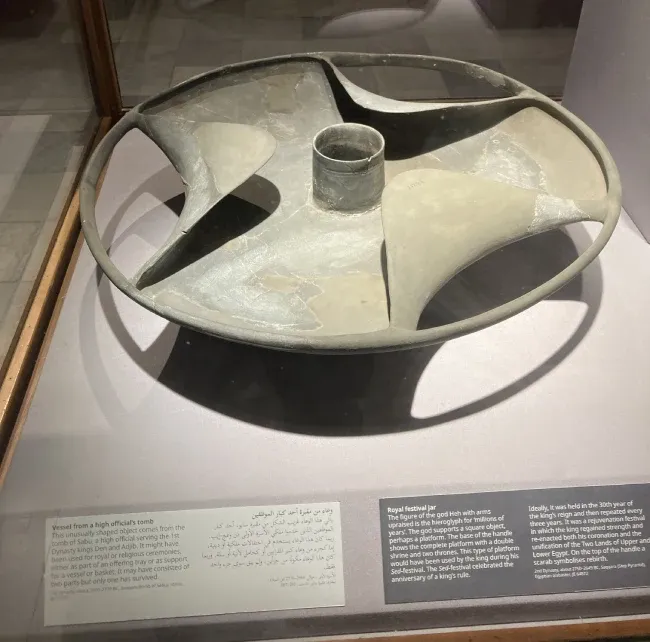
Hidden deep within the sands of Egyptian antiquity lies a mysterious object that has puzzled archaeologists and historians for decades — The Sabu Disk. Unearthed in 1936 by British archaeologist Walter Bryan Emery during the excavation of the tomb of Prince Sabu at Saqqara, this enigmatic artifact continues to ignite debate around its origin, purpose, and even the level of technological sophistication possessed by the ancient Egyptians. The Sabu Disk, approximately 61 cm in diameter, carved from a single piece of metamorphic schist, stands as one of ancient Egypt’s most baffling creations. Its complex design, featuring three curved lobes and a central hub, seems far ahead of its time, igniting theories that range from ceremonial use to advanced mechanical function.
To the untrained eye, the disk may seem like a simple ornamental piece. Yet, its intricate geometry and material choice suggest otherwise. The schist stone, notoriously fragile and difficult to shape, would have required exceptional craftsmanship and precision to carve without shattering. Its discovery inside a tomb from Egypt’s First Dynasty — around 3000 BCE — compounds the mystery. As modern researchers continue to study The Sabu Disk, its potential implications for understanding early Egyptian engineering remain profound. Could it have served as a part of a lost technology, or was it a symbolic artifact representing spiritual concepts? Whatever the truth, the Sabu Disk captures the imagination of all who encounter it, offering a tantalizing glimpse into the ingenuity and mystery of Egypt’s earliest civilization.
The Tomb of Prince Sabu and the Discovery of the Disk
When Walter Bryan Emery uncovered the tomb of Prince Sabu, son of Pharaoh Anedjib, he hardly anticipated unearthing an artifact that would challenge modern comprehension. The tomb, located within the Sakkara Necropolis, was typical of elite burials of Egypt’s First Dynasty, filled with stone vessels, tools, and objects of daily and ritual use. However, among the relics lay a disk unlike any other known Egyptian artifact. Measuring roughly two feet in diameter and half an inch thick, the Sabu Disk was found broken into several pieces — possibly due to the collapse of the tomb roof. Once reconstructed, its form astonished Emery and his team, who struggled to classify it into any known category of ancient Egyptian items.
The discovery site itself adds an additional layer of intrigue. Saqqara, a sprawling necropolis near Memphis, served as the burial ground for Egypt’s earliest dynasties. The area would later become home to iconic structures like the Step Pyramid of Djoser and sites included in many Cairo Day Tours. Prince Sabu’s tomb, however, predates these monumental achievements, situating the disk at the dawn of Egyptian state formation. This context underscores the Sabu Disk’s importance — not merely as an archaeological artifact but as a symbol of technological or ceremonial sophistication long before Egypt’s golden age.
The Physical Characteristics of the Sabu Disk
The Sabu Disk is carved from metamorphic schist, a stone that splits easily under pressure. This choice of material immediately rules out any casual or utilitarian purpose since the disk’s thin, curved blades would have been too fragile for daily use. Its circular design, with three outward-curving lobes and a central aperture, hints at complex mechanical thinking. Some researchers have compared its form to early turbine or propeller concepts, while others view it as purely symbolic. The smoothness of its contours and symmetrical design demonstrate advanced techniques in stone carving that surpass expectations for the period.
Many Egyptologists assert that carving such an object would require tools or methods not yet discovered from that era. The schist material, being fine-grained, would necessitate abrasives or precise cutting tools — possibly copper with sand or quartz dust. The fact that Egyptian craftsmen accomplished this over 5,000 years ago continues to raise eyebrows among modern engineers. Those touring Egypt today often marvel at the precision found in ancient constructions, from the Great Pyramids of Giza to the temples of Abu Simbel. The Sabu Disk fits perfectly into this narrative of mastery over materials and geometry.
Possible Theories Behind the Function of the Sabu Disk
Scholars and enthusiasts have proposed multiple interpretations of the Sabu Disk’s purpose. Some mainstream Egyptologists suggest it might have been a decorative incense holder or ceremonial lamp, citing the central hole as a possible socket. Others point toward its symbolic representation of solar or cosmic themes — the three lobes perhaps reflecting triadic deities or celestial movement. Yet, alternative theories have gained traction in recent decades, fueled by the disk’s distinctly mechanical form.
One theory proposes that the disk was part of a primitive pump or rotational device connected to water or air flow, hinting at early fluid dynamics understanding. Another suggests it was a model or component of a larger apparatus, perhaps linked to astronomical observation or energy transmission. While such claims remain speculative, they reveal how the artifact transcends conventional classification. The Sabu Disk’s aerodynamic design has even led some to argue it reflects knowledge beyond what we attribute to early dynastic Egypt — though most scientists maintain skepticism toward extraterrestrial explanations.
The Symbolism of the Disk in Early Egyptian Thought
In ancient Egyptian cosmology, circular shapes held deep religious meaning, often symbolizing the sun, eternity, and cyclical renewal. The disk’s tri-lobed design could have represented the union of heaven, earth, and the underworld — a central theme in Egypt’s mythological framework. The tomb of Prince Sabu, being a royal burial, supports this interpretation. Ritual objects accompanying the deceased were intended to ensure safe passage into the afterlife, and the Sabu Disk might have served as a metaphoric vessel facilitating spiritual transformation.
It’s also worth noting that early dynastic iconography often emphasized rotational symmetry and balance, concepts later echoed in monumental architecture. From circular offering tables to the alignment of the Karnak Temple, Egyptians demonstrated a keen awareness of geometry and cosmic alignment. The Sabu Disk may thus represent a physical manifestation of that metaphysical understanding — a sacred geometry bridging the divine and the material.
The Sabu Disk in Modern Research and Museum Studies
Today, the Sabu Disk resides in the Egyptian Museum of Cairo, drawing fascination from visitors and researchers alike. Modern imaging and 3D scanning techniques have been employed to analyze its precise curvature and manufacturing marks. These studies confirm that the object’s symmetry is deliberate and not accidental — reinforcing the notion that ancient craftsmen possessed a remarkable degree of precision.
Recent archaeological debates have shifted toward understanding the disk within the broader context of early dynastic engineering. Some scholars compare it to early examples of Egyptian stone vessels that exhibit similar hollowing techniques. Others emphasize experimental archaeology — recreating the disk with period-accurate tools — to test its feasibility. Even with advanced replication efforts, few have succeeded in matching the original artifact’s finesse, underscoring just how ahead of its time it appears.
Connections to Broader Egyptian Engineering Achievements
The Sabu Disk’s sophistication aligns with other astonishing feats from early Egypt. From the alignment precision of the Valley Temple in Giza to the balanced symmetry of the Nubian Museum collections, ancient Egyptians displayed engineering prowess unmatched for millennia. The disk’s aerodynamic shape might have influenced later symbolic objects or served as an early experiment in balance and rotation — precursors to the wheel and pulley systems that would eventually emerge in later civilizations.
When placed within Egypt’s grand narrative of innovation, the Sabu Disk stands as testimony to human curiosity and craftsmanship. Whether a sacred symbol or a functional device, it embodies the spirit of exploration that defined Egyptian culture — a civilization that combined art, science, and spirituality seamlessly, much like the intricate balance encapsulated within this singular object.
FAQs About The Sabu Disk
What is the Sabu Disk made of?
The Sabu Disk is carved from metamorphic schist, a fine-grained stone known for its fragility. Despite its tendency to fracture easily, ancient Egyptian artisans managed to sculpt it into a perfectly balanced form, showcasing incredible precision and control over material properties.
Where was the Sabu Disk discovered?
It was unearthed in 1936 by Walter Bryan Emery inside the tomb of Prince Sabu at the Saqqara Necropolis, Egypt. This site houses several significant First Dynasty burials, providing insight into Egypt’s earliest royal traditions.
What was the purpose of the Sabu Disk?
The true purpose remains unknown. Theories range from a ceremonial item symbolizing the cosmos to a functional component of an unknown mechanism. Its design continues to inspire debate among archaeologists, engineers, and historians alike.
Can visitors see the Sabu Disk today?
Yes, the artifact is displayed at the Egyptian Museum in Cairo. Many travelers exploring Egypt’s cultural heritage on tours like Luxury Egypt Tours include visits to this museum to witness the disk firsthand and marvel at its craftsmanship.
Why is the Sabu Disk considered unique in ancient Egyptian archaeology?
Unlike any other known artifact from Egypt or the ancient world, its mechanical-like design, precision, and material make it a one-of-a-kind discovery. It challenges assumptions about early technological capabilities and continues to provoke fresh research and fascination among Egyptologists worldwide.


