

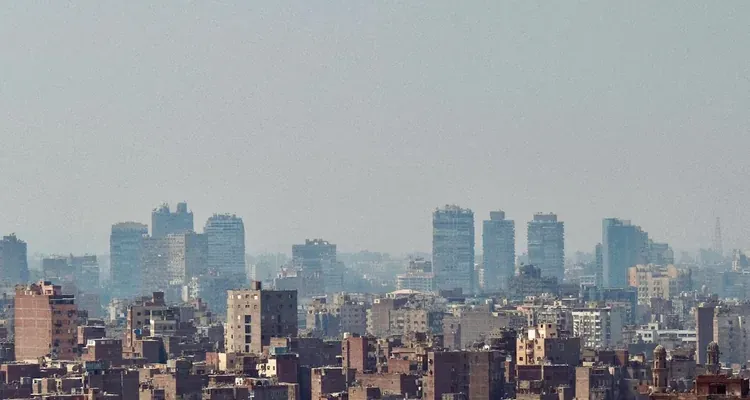
Solar Eclipse in Cairo 2027: Visibility, Times and What Residents Will See
On 2 August 2027 the sky over Cairo will dim in the middle of the afternoon as the Moon covers almost the entire Sun. Almost — and that word carries more weight than most people expect.
This article sets out exactly what the solar eclipse Cairo 2027 will look like from the capital: whether it is total or partial, the timings, how much of the Sun disappears, and how the view from Cairo differs from the view 500 kilometres to the south.
Will Cairo See a Total Solar Eclipse in 2027?
No. Cairo lies north of the path of totality. The capital will see a deep partial solar eclipse.
This is the single most important fact about the eclipse in Cairo, and it is worth stating plainly because a great deal of coverage blurs it. The Moon's dark inner shadow — the umbra, the part that produces a true total eclipse — passes across Upper Egypt. Cairo, Giza, Alexandria and the Delta sit outside that corridor and remain in the lighter outer shadow throughout.
How Much of the Sun Will Be Covered in Cairo?
At maximum eclipse, approximately 94.7% of the Sun's disc will be covered from Cairo, corresponding to an eclipse magnitude of about 0.946.
That is a very deep partial eclipse — among the most substantial Cairo has seen in years. But the remaining sliver of Sun, small as it is, remains overwhelmingly bright. This is the part that surprises people.
Solar Eclipse Timing in Cairo 2027
The phases in Cairo run approximately as follows, in Egyptian local time:
| Phase | Local time |
|---|---|
| Partial eclipse begins | about 11:33 |
| Maximum eclipse (94.7% covered) | about 12:55 |
| Partial eclipse ends | about 14:17 |
The complete event lasts roughly 2 hours and 44 minutes. At maximum the Sun stands 78° above the horizon, so it will be high overhead and visible from almost anywhere with a patch of open sky.
These local times assume Egypt observes summer time (EEST, UTC+3) in August 2027. Egypt has changed its daylight-saving arrangements several times in recent years, and some published sources quote times an hour earlier on the opposite assumption. The astronomical moment is fixed — greatest eclipse for the event occurs at about 10:06 UTC — so if in doubt, confirm Egypt's clock offset closer to the date and calculate from UTC.
What Will the Eclipse Look Like in Cairo?
Over the course of about eighty minutes the Sun will narrow to a thin crescent. Near maximum, the light across the city will take on the peculiar quality that only an eclipse produces — not the warm dimming of dusk but something flatter and more silvery, with unusually sharp shadows. The temperature will ease slightly. Under trees, the gaps between leaves will project hundreds of small crescents onto the pavement, each one an image of the eclipsed Sun.
What will not happen in Cairo:
- The sky will not go dark. It will dim, noticeably, but daylight remains.
- The corona will not appear. The Sun's outer atmosphere stays invisible whenever any part of the bright disc is showing.
- Stars and planets will not come out.
- There is no point at which it is safe to remove eye protection. Not for a second.
The Difference Between the Cairo and Luxor Eclipse
It is tempting to think 94.7% means Cairo gets nearly the whole experience. It does not, and the reason is physical rather than a matter of degree.
The Sun's surface is extraordinarily bright. Even a 5% sliver still outshines the corona by a wide margin and keeps the sky lit. Totality is a threshold, not a slope: everything that makes a total eclipse famous — the corona, the darkness, the visible planets, the 360-degree twilight — appears only once the disc is completely covered, and appears all at once.
| Cairo | Luxor | |
|---|---|---|
| Type | Partial | Total |
| Sun covered | about 94.7% | 100% |
| Totality | None | About 6 min 22 sec |
| Corona visible | No | Yes |
| Darkness | Dimming only | Twilight, stars visible |
| Filters | Required throughout | Off during totality only |
Astronomers are unusually blunt on this point: a 99% partial eclipse and a total eclipse are different events, not different amounts of the same event. If seeing the corona matters to you, the only option is to be inside the path — which in Egypt means travelling south to Luxor or the surrounding region.
Where to Watch the Eclipse in Cairo
With the Sun 78° above the horizon at maximum, no special vantage point is needed — anywhere with a clear view of the sky will do. A rooftop, a park, a stretch of open ground beside the Nile, or the desert edge near the Pyramids of Giza all work equally well for the eclipse itself. Choose for comfort, shade between phases, and somewhere to sit; August in Cairo is hot and the event runs the better part of three hours.
What matters far more than location is equipment.
Eye safety — non-negotiable in Cairo
Because Cairo never reaches totality, the Sun must be viewed through certified eclipse glasses or a proper solar filter for the entire duration. There is no safe window at any moment.
Sunglasses — including stacked pairs — are not safe. Neither are exposed film, smoked glass, CDs, or looking at a phone screen pointed at the Sun. Cameras, binoculars and telescopes need a purpose-made filter fitted over the front; a filter that screws in at the eyepiece can crack under concentrated heat.
A safe and genuinely enjoyable alternative is indirect viewing: pinhole projection through a piece of card onto a pale surface shows the crescent Sun clearly and can be watched by any number of people at once.
If You Want to See Totality Instead
Cairo's partial eclipse is worth stepping outside for. But the total eclipse is a few hundred kilometres south, and it will not return to Egypt on this scale within any reader's lifetime — the next totality of comparable length over accessible land falls on 3 June 2114.
Egypt Top Tours runs journeys positioned inside the path of totality, including options that combine Cairo with Upper Egypt so you can see the capital and still be in the right place on eclipse day:
- Egypt Solar Eclipse Travel Package: Cairo, Luxor & Red Sea
- Luxor Egypt Solar Eclipse Tour
- 07 Days Egypt Solar Eclipse Tour
- 07 Days Egypt Solar Eclipse Trip
- 05 Days Egypt Solar Eclipse Itinerary
Read More
- Total Solar Eclipse in Egypt 2027: Date, Path and Everything You Need to Know
- Solar Eclipse in Luxor 2027: Why It Is One of the Best Places to Watch Totality
Frequently Asked Questions
Will the solar eclipse be visible in Cairo?
Yes. Cairo will see a deep partial solar eclipse, with about 94.7% of the Sun covered at maximum.
Will Cairo see a total solar eclipse in 2027?
No. Cairo lies north of the path of totality. Only Upper Egypt, including Luxor, experiences the total phase.
What time is the solar eclipse in Cairo?
The partial eclipse begins around 11:33 local time, reaches maximum near 12:55 and ends about 14:17 — roughly 2 hours 44 minutes in total. Times assume Egypt is on UTC+3 that August.
How much of the Sun will be covered in Cairo?
About 94.7% of the solar disc at maximum, an eclipse magnitude of roughly 0.946.
How long will the Cairo eclipse last?
Approximately 2 hours and 44 minutes from first contact to last. There is no period of totality at any point.
What is the difference between the Cairo and Luxor eclipse?
Cairo sees a partial eclipse with no corona, no darkness and filters required throughout. Luxor sees about 6 minutes 22 seconds of totality, with the corona visible, stars appearing and daylight replaced by twilight. Even at 94.7%, the Cairo view is a fundamentally different event.
Do I need eclipse glasses in Cairo?
Yes, for the entire eclipse. Because Cairo never reaches totality, there is no moment at which it is safe to look at the Sun without a certified filter.
Planning your trip? Explore our Egypt travel packages.
Related reading: Solar Eclipse in Luxor 2027: Totality Times & Why Luxor Is B · Total Solar Eclipse in Egypt 2027: Date, Path & Full Guide.